
 RU
 UZ
 EN
 Personal account

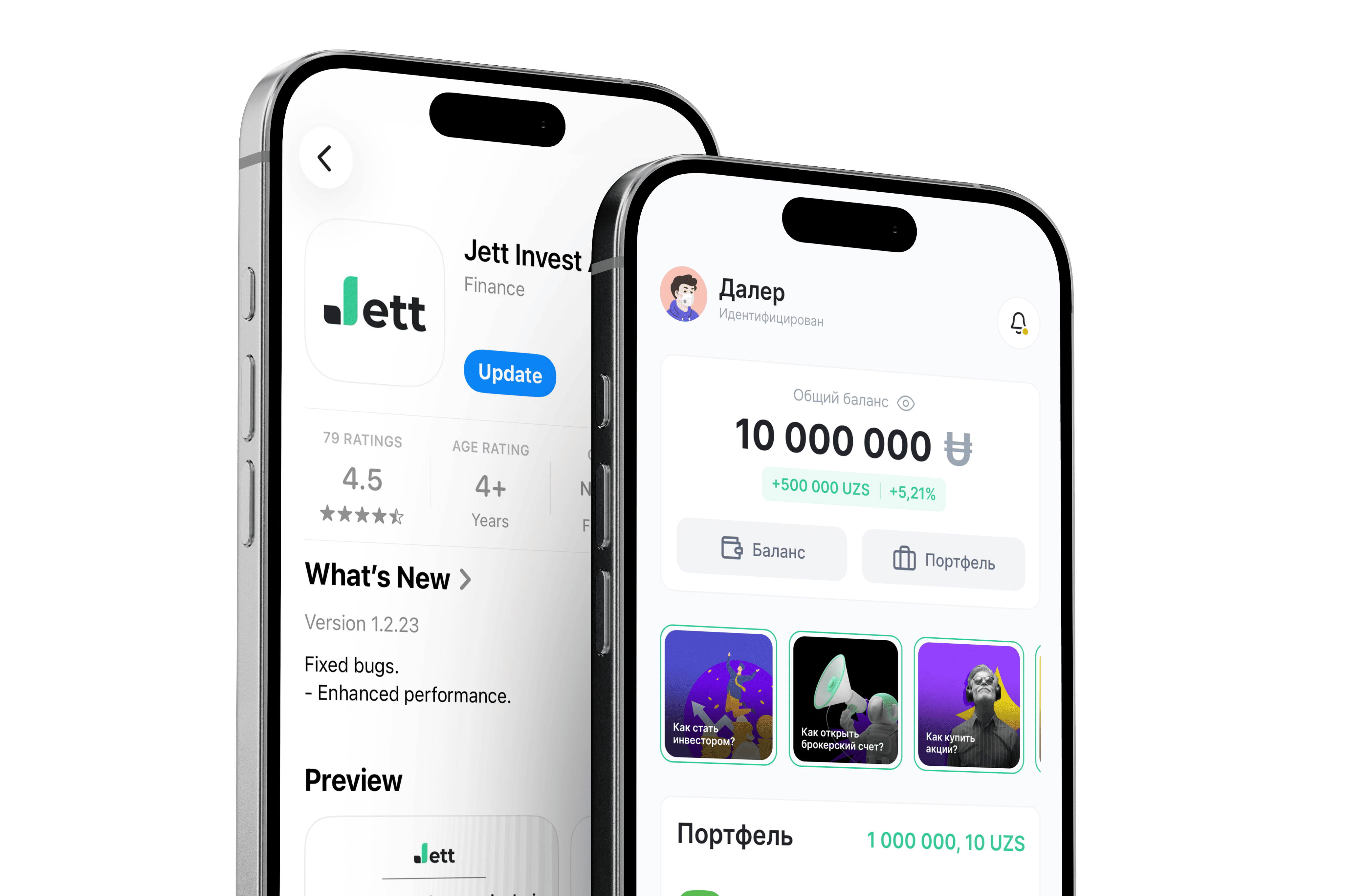
Investment portfolio inside the app
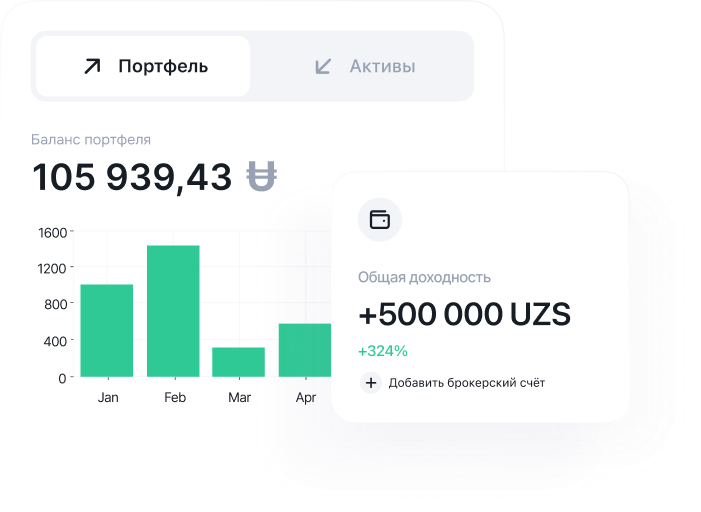
Build your portfolio and analyze its performance with convenient tools, earn income from selling shares or from dividends
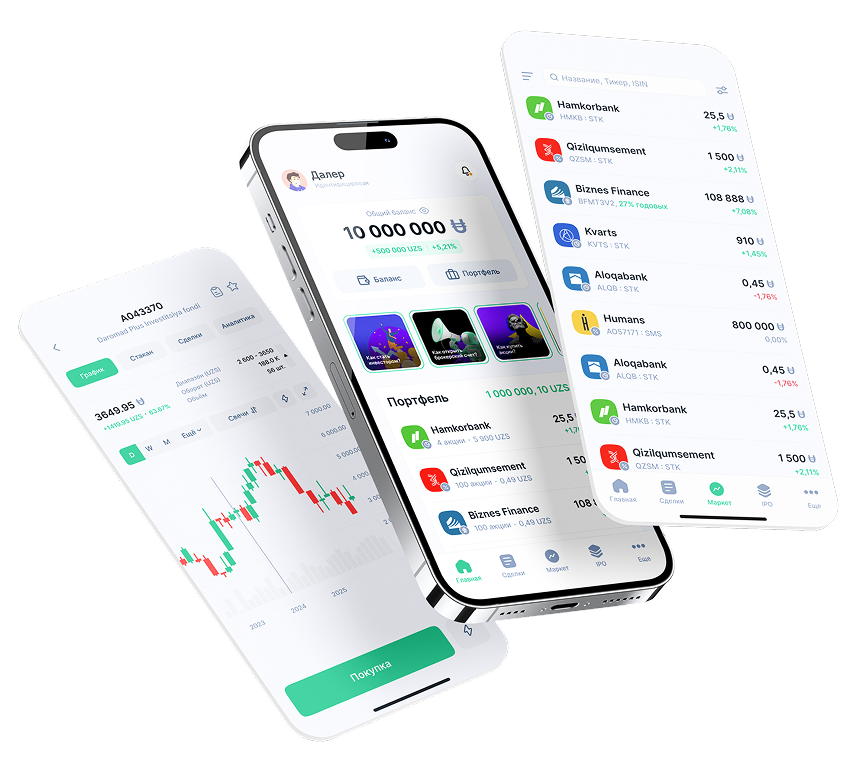
Jett gives you access to Uzbekistan's stock market opportunities and helps you grow your capital by investing in securities



 800K+
Users trust our service, and we have a significant impact on Uzbekistan's securities market.
Build your portfolio and analyze its performance with convenient tools, earn income from selling shares or from dividends

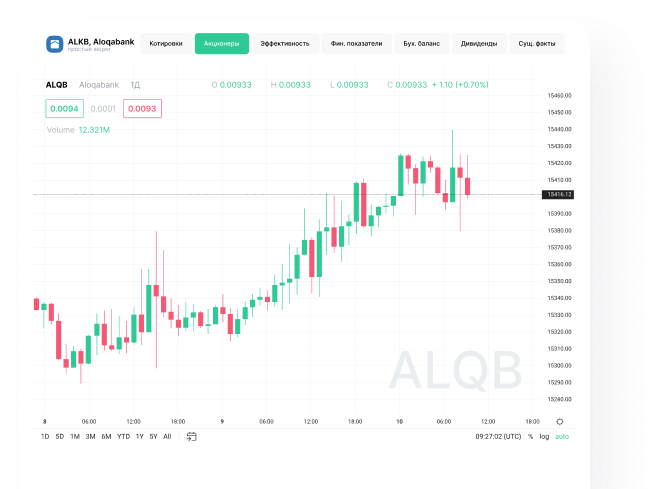
In Jett you can perform deeper analysis of Uzbek stock market securities using professional charts and indicators in full-screen mode

You can open a brokerage account remotely in 15 minutes, connect existing accounts, switch between them and see the overall picture across all your brokerage accounts
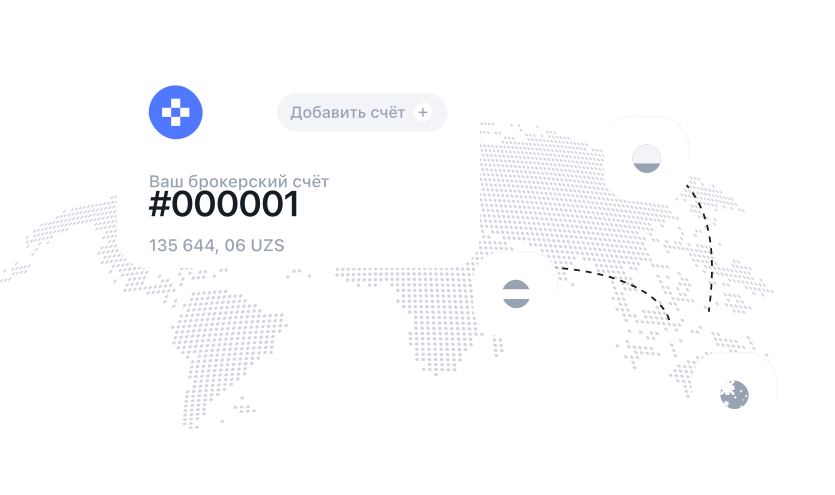

On the home screen you can add or open a brokerage account

Enter your passport series and date of birth, then complete remote identification
Your account will be opened within 15 minutes during exchange trading hours (9:30 AM to 4:00 PM on weekdays)
StartEverything you need to work with securities — in a convenient mobile app. Download Jett and start exploring the opportunities of the stock market.

There are three types of participants in the stock market:
Issuers - companies that issue and sell their securities;
Investors are individuals or companies that buy securities;
Professional participants are organizations that service the process of issuing, buying and selling and storing securities. These are the exchange, brokers, banks, depository and regulators.
Securities are financial instruments that grant their holders property or financial rights. With the development of information technology, most securities today exist in electronic (digital) form rather than as physical documents.
Securities entitle their holders to receive a portion of a company's income and participate in its activities or, depending on the type of security, to receive repayment of a debt with interest.
At the "Tashkent" Republican Stock Exchange, individual investors can purchase shares and bonds issued by Uzbek companies.
A share represents ownership in a company. Shareholders become partial owners of the company. They may be entitled to receive dividends (if the company pays them) and participate in the company's management by voting on matters presented at shareholders' meetings. There are two types of shares: ordinary and preferred. Companies that issue shares are also known as joint-stock companies (JSCs).
Ordinary shares carry voting rights. This means that any shareholder who owns ordinary shares may participate in the company's general meeting of shareholders and vote on the matters presented. Holders of ordinary shares may receive dividends from the company's net profit if the company's management makes such a decision.
For example: if a company's net profit is 100 million soums and a decision is made to allocate 60 million soums to shareholders, this 60 million soums is distributed equally among all holders of ordinary shares.
Preferred shares differ from ordinary shares because they do not grant their holders the right to participate in the management of the joint-stock company by voting at shareholders' meetings. In exchange for giving up this right, preferred shares entitle their holders to receive a fixed dividend based on the nominal value of the shares, regardless of the company's profits.
For example: if the nominal value of a preferred share is 10,000 soums and the dividend rate is 20%, its holder receives an annual dividend of 2,000 soums, regardless of whether the company makes a profit.
In addition, if the company is liquidated, holders of preferred shares have the right to receive a specified portion of the company's assets before any remaining assets are distributed among holders of ordinary shares.
It should also be noted that ordinary shares are generally considered more liquid than preferred shares.
Dividends are the portion of a company's profit remaining after all taxes have been paid, which is distributed among its shareholders. By decision of the general meeting of shareholders, dividends may be paid in cash or in the form of the company's securities. Individuals registered in the company's shareholders’ register are entitled to receive dividends on their shares. The general meeting of shareholders decides on the payment of dividends to shareholders.
When paying dividends, the company first pays dividends on preferred shares, followed by dividends on ordinary shares. If the company has sufficient income to pay the dividends established for preferred shares, it is not entitled to refuse to pay dividends to the holders of such shares.
Dividends can be received automatically through the UzCSD app. You can download the UzCSD app from the Play Store or App Store.
A company's shareholders’ register is a record of shareholders registered as of a specific date. It contains information about the names, quantities, nominal values, and types of shares they own, as well as contact details that enable the company to send information to the persons registered in the shareholders’ register.
Liquidity is the speed at which an asset can be converted into cash. In simple terms, liquidity answers the question: "How quickly can I sell a particular asset?"
There are several levels of asset liquidity: highly liquid, low-liquid, and illiquid assets. Cash is considered the only completely liquid asset. Real estate can be classified as a low-liquid asset because selling a property at market value is not an immediate process and can take a considerable amount of time. Overdue debts and similar items are examples of illiquid assets.
Securities traded on the stock exchange also have liquidity.
Liquidity is one of the most important characteristics of these assets, as the success of investing in securities largely depends on it. High liquidity allows investors to buy or sell any quantity of shares immediately at an attractive price. If shares are highly liquid, investors do not have to sell them at a significant discount or pay considerably more than their market value when purchasing them.
Aksiyalarning likvidligi savdo hajmi (amalga oshirilgan bitimlar soni) va spred hajmi bo'yicha baholanadi. Aksiyalarning likvidligini aniqlash uchun savdo jadvallarini tahlil qilish lozim. Agar kompaniyaning aksiyalari bo’yicha ko'plab bitimlar amalga oshirilsa, ularning narxi tez-tez o'zgarib turadi va jadvalda ko'plab cho'qqilar aks etadi. Agar jadvalda ko'plab uzun gorizontal hududlar mavjud bo'lsa, unda, ehtimol, bunday qimmatli qog'ozlar bo’yicha bitimlar kamdan-kam amalga oshiriladi, bunday aksiyalar past likvidlikka ega.
A spread is an important indicator of a stock's liquidity. It is the difference between the best available prices offered by buyers and sellers: the lowest asking price (ask) and the highest bidding price (bid). The higher the trading volume and the narrower the spread, the more liquid the security is.
Trading volume largely depends on the demand for a particular company's securities. High demand is usually observed for shares of well-known, stable, and financially sound companies that regularly pay dividends, have strong growth prospects, and continue to develop consistently.
Liquidity is an important factor when evaluating investments. High liquidity can be a useful indicator for beginner investors who have little experience in the stock market. The liquidity of securities refers to the ability to sell them quickly at a price close to their current market value.
The nominal value of a share and its value on the stock exchange (market price) are two different and independent concepts. The nominal value of a share usually refers to the monetary amount representing that share's portion of the authorized capital of the company that issued it.
Securities are traded at their nominal value only during their initial issuance. Shares that are not sold at their nominal value are listed on the stock exchange through an IPO, where they are traded at market prices determined by supply and demand from buyers and sellers.
In most cases, knowing the nominal value of ordinary shares is not important for investors when selling them, as trading takes place at market prices. Shares are distributed at their nominal value only among initial investors. The nominal value is used to calculate dividends on preferred shares and coupon payments on bonds.
An IPO (Initial Public Offering) is the first public sale of a company's shares to an unrestricted number of investors. During an IPO, a company issues shares and lists them on the stock exchange. Any investor or investment fund can purchase these shares and thereby become a shareholder in the company.
An IPO (Initial Public Offering) is a complex process for a company. To go public, a company must have a strong business track record and prepare transparent financial reports for several years. The process involves several stages and requires the participation of underwriters, brokers, consultants, lawyers, sales representatives, and other professionals.
The main stages are:
The company prepares its financial statements and evaluates its financial position and business performance.
The company selects the stock exchange, the type of offering, and the underwriters, who help assess risks and develop the IPO strategy.
Before trading begins on the stock exchange, a book of orders is created from investors interested in purchasing the shares. Once the book-building process is complete, the company and its underwriters determine the price per share and the number of shares to be offered.
The securities are allocated among investors based on the order book, after which trading on the stock exchange begins.
There are three ways to earn income from investing in securities:
Through an increase in the share price. You purchase shares and expect their price to rise in the future. When you sell them, you earn a profit equal to the difference between the purchase price and the selling price.
Through dividends on ordinary shares. If the company makes a profit at the end of the year and the general meeting of shareholders decides to distribute it among shareholders, you receive a dividend for each share you own.
Through dividends on preferred shares. Preferred shares provide their holders with a predetermined dividend amount.
An investor purchases bonds, thereby lending money to a company or the government. In return, the investor receives a predetermined income over a specified period.
Unfortunately, there are no universal rules. No one can accurately predict the best time to buy or sell shares or other types of securities. Each investor must make this decision independently.
There are two main methods of securities analysis:
Fundamental analysis
Technical analysis
During fundamental analysis, an investor examines a company's financial and accounting statements, as well as economic and market factors, to determine the fair value of its shares. If the fair value is higher than the current market price, purchasing the shares may be worth considering, as they may be undervalued.
Technical analysis is the study of changes in stock prices shown on charts. As prices move, they form certain patterns or figures on charts. Just as people tend to repeat their habits, price patterns also tend to repeat over time. When technical analysts notice the formation of one of these patterns, they can estimate what the next price movement might be.
Four key recommendations:
It is best to start investing with an amount you are prepared to lose. This is not pessimistic thinking, but a realistic approach: few people succeed in making a profit from securities trading on their first attempt. As you learn about the market, gain knowledge, and build experience, you can gradually increase your investments. Under no circumstances should you invest your last available money or funds borrowed from a bank.
Build a diversified portfolio. In other words, do not invest all your money in a single company; instead, create a portfolio consisting of different securities. It is even better if these securities represent companies from various industries. The main purpose of diversification is to reduce risk: even if the value of some securities in your portfolio decreases, this may be offset by the growth of other assets.
Study analysts' materials. Trading ideas from brokers and analytical companies can help you choose assets to invest in. Such ideas usually include a target price and analysts' recommendations on whether to buy or sell a particular security.
Consider purchasing a ready-made portfolio. When building your own investment portfolio, you can also consider ready-made investment suggestions from experienced participants in the financial market.
An investment portfolio is a collection of securities purchased by an investor to generate income.
Yes, the greatest risk of investing in securities is the possibility of losing all your investments.
Investing in securities does not guarantee a return.
A broker acts as an intermediary between investors and the stock exchange.
A broker is a company licensed to operate in the stock market and authorized to trade securities on behalf of investors. In return for providing intermediary services, the broker charges a commission, which is specified in the brokerage service agreement.
A brokerage account is a special account used for trading securities on the stock exchange. It is opened by a broker, a professional participant in the securities market.
With a brokerage account, you can not only buy and sell shares and bonds but also deposit and withdraw funds.
When a brokerage account is opened, a depository account is automatically opened for the client.
A securities account, also known as a depository account, is automatically opened together with a brokerage account. While a brokerage account is used to transfer funds for transactions, purchased securities are held in the depository account. When securities are credited to this account, the depository registers the new owner.
Your securities are held at the State Enterprise "Central Securities Depository".
The Central Securities Depository (CSD) maintains records of ownership rights to securities belonging to investors and processes settlements for transactions. It also opens accounts for other depositories, including brokers.
A brokerage company must have an "Investment Intermediary" license. You can check whether the broker holds a license on its website or by contacting the broker directly.
You can also contact the Ministry of Economy and Finance to verify the license or check the list of exchange members on the "Tashkent" Republican Stock Exchange website: uzse.uz/exchange/members/
When transactions are concluded on the stock exchange, the seller pays a tax amounting to 0.01% of the transaction value. However, the income earned by the seller from the completed transaction is exempt from personal income tax. Income earned by individuals in the form of dividends on shares is also exempt from personal income tax.
This is because Uzbekistan is implementing measures to attract investors to the stock market.
Currently, obtaining halal certification for securities issued by joint-stock companies in Uzbekistan is not yet widespread. Nevertheless, some companies conduct special assessments to determine whether their business activities and financial indicators comply with international halal standards. To stay informed, investors should regularly follow news and updates from securities issuers.
1. Download the Jett Invest app from the Play Market or App Store using the download link;
2. Create an account in the app using your phone number;
3. Tap the “Open Account” button and submit an application to open a brokerage account online;
4. Read the investment intermediary's service agreement and the Jett service terms of use, confirm your agreement, and submit the application.
Link to the detailed guide: https://telegra.ph/Brokerlik-hisobraqami-ochish-06-24
“Finance Invest Brok” is an investment consulting company that provides brokerage services, asset management, and investment banking support. “Finance Invest Brok” holds all the licenses required to carry out professional activities in the securities market of Uzbekistan.
Company website: finbrok.uz
No, Jett is a mobile app for trading securities. Jett users can open a brokerage account with a licensed broker through the app.
A brokerage account can be closed by submitting a written application to the broker.
To sell securities, tap the “Portfolio” button on the investment service’s home page and go to the “Assets” page. Here, you can view a chart showing the distribution of your current assets and a list of your securities.
Select the company you want to sell shares of from the list, tap the “Sell” button, and enter the number of shares you wish to sell.
Tap the “Continue” button to view the transaction details, including the total transaction amount, commission rate, and the total amount you will receive from the sale.
After completing these steps, you can go to the “Transactions” page to check the status of your sell order.
Funds are credited to the brokerage account within 1 second after payment during the working hours of the "Tashkent" Republican Stock Exchange (on business days, from 9:30 AM to 4:00 PM).
A brokerage account through Jett is opened online within 15 minutes after submitting an application during the working hours of the "Tashkent" Republican Stock Exchange (on business days, from 9:30 AM to 4:00 PM).
If you submit an application to open an account outside the exchange's working hours, your account will be opened within 15 minutes after the exchange opens on the next business day.
It is a mobile investment service that allows users to buy and sell shares and bonds issued by Uzbek companies.
You can view Jett service fees and commissions on the jett.uz website. The commissions are listed at the bottom of the page.
Uzbekistani citizens aged 18 and over, as well as non-residents living in Uzbekistan, can open a brokerage account online through the Jett service. Foreign citizens can open an account by contacting the broker directly via Telegram at @jett_support.
Through the licensed broker “Finance Invest Brok”.
The fee for opening a brokerage account online through the Jett service is UZS 12,000.
There is no minimum deposit requirement to start trading through Jett. You can fund your brokerage account with at least UZS 10,000 and start trading.
1. On the main page of the “Balance” section, tap the “Top Up” button and enter the amount you wish to deposit on the page that opens;
2. Select a card linked to the app. If your card is not linked to the app, tap “Add Card”;
3. Tap “Next”, review the detailed information, and then tap “Top Up”.
Link to the detailed guide: https://telegra.ph/Brokerlik-hisobraqami-toldirish-va-undan-mablaglarni-chiqarish-06-25
1. Go to the “Market” page in the bottom menu. Here, you can view a list of all companies whose securities are available for sale.
2. Select a company from the list and tap the “Buy” button. You can then purchase shares instantly at the market price (market order) or place a pending order at your preferred price (limit order).
Link to the detailed guide: https://telegra.ph/Qimmatli-qogozlarni-sotib-olish-va-sotish-06-26
Link to the video guide: https://youtu.be/ho5D2h6Q1hY
1. On the home page of the “Home” section, tap your account balance and select “Withdraw”;
2. Enter the amount you wish to withdraw, select the card to which the funds should be transferred, and submit your withdrawal request.
Once you submit a withdrawal request from your brokerage account, the funds will be transferred within 1 exchange business day.
Link to the detailed guide: https://telegra.ph/Brokerlik-hisobraqami-toldirish-va-undan-mablaglarni-chiqarish-06-25
Jett is currently available to clients of the following partner brokers that have official agreements with the service: Silk Capital, ALKES, Freedom Broker, Leader Finance Capital, Portfolio Investment, HB Capital, Finance Invest Brok.
If you have an account with any of the brokers listed above, you can log in without opening a new account and trade securities through Jett.

